$$PLAIN_TEXT_PREVIEW$$

View in Browser

Ancient Forest Society

Ancient Forest Society


Things I Didn’t Know About Giant Sequoias

by Bianca Thomas, Volunteer from the UK

The first time I really saw a giant sequoia was in July 2024 with the Ancient Forest Society as a volunteer, helping scientists Wendy and Anthony understand how these trees grow and adapt to fire and drought. By saw, I mean the wide-eyed awe you feel when you’re incredulous about what is actually in front of you.

We have all three species of redwoods in the UK: giant sequoias, coastal redwoods, and dawn redwoods. In fact, we have a surprising number of them — around half a million combined. I have climbed all three species back home, but they are infants in comparison. Ours are the result of the plant-hunting era and the Victorian fascination with the weird and wonderful, planted mostly in the mid-1800s. Despite growing extremely well in our temperate, low-altitude environment, they are, biologically speaking, still very young and nothing like the native Californian trees of the mid-altitude groves.

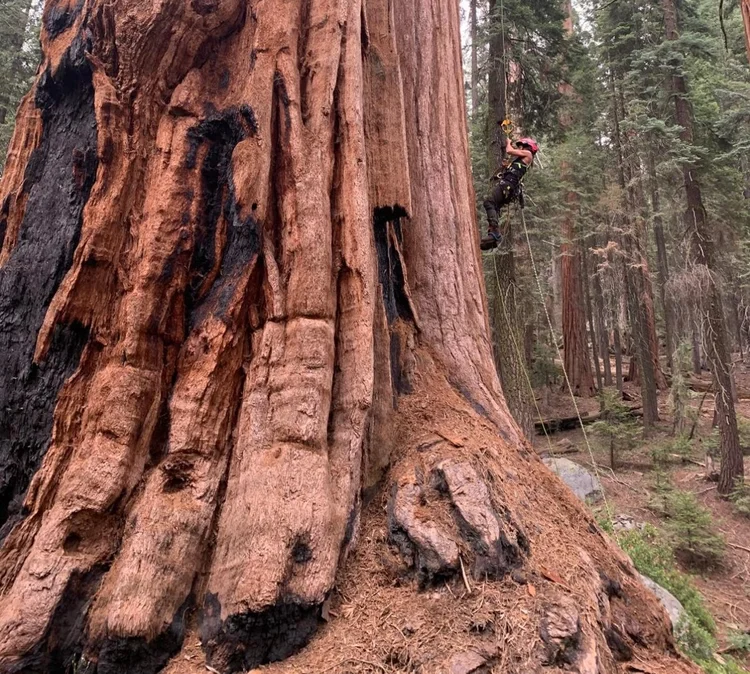
The tree that took my breath away as I tightened my climbing harness with sweaty palms was a truly ginormous tree called Gemini, in a grove called Giant Forest. It’s actually one of two sequoias growing so close their trunks fused together, reaching close to 300 feet into the sky. It’s so tall you can’t see the top from the ground, only metres and metres of thick, fire-scarred, orange bark rising out of view. That moment quietly altered my path as a climbing arborist — it was through these trees that my thinking about trees, and the way I worked, began to change.

Bianca climbing Gemini for the first time. Sequoia National Park. Photo by Alasdair Wolski.

One of the first things that surprised me about the old-growth trees of Giant Forest, and something I would never have guessed before learning about the data from Anthony and Wendy, is that giant sequoias don’t slow down as they age. As long as they maintain healthy crowns, they continue to put down more total wood each year — not less. Even very old individuals (two to three-thousand-year-old trees) can still be adding substantial amounts of woody tissue annually. A narrow growth ring on a trunk of this size represents an extraordinary volume of wood. And growth at this scale isn’t just about wood — it also reflects continued investment in foliage and crown biomass. It makes me wonder — without human intervention and disease, how old could these trees live?

Climbing higher into the canopy revealed something else that challenged my assumptions. The tops of giant sequoias are often dead. Instead of this signalling decline, it might be part of how these trees persist and continue. New crowns frequently form below the dead tops — younger, reiterating growth emerging from an older framework, a bit like new growth on old bones. The tree isn’t trying to preserve every part of itself indefinitely. It reorganises and replaces. It keeps going by renewing parts rather than maintaining a single, permanent structure. This is the juxtaposition of aging trees. Unlike us humans who can only age in one direction, trees can be made up of younger parts — semiautonomous units of differing ages — aging not only linearly, but a bit sidewards and sometimes backwards.

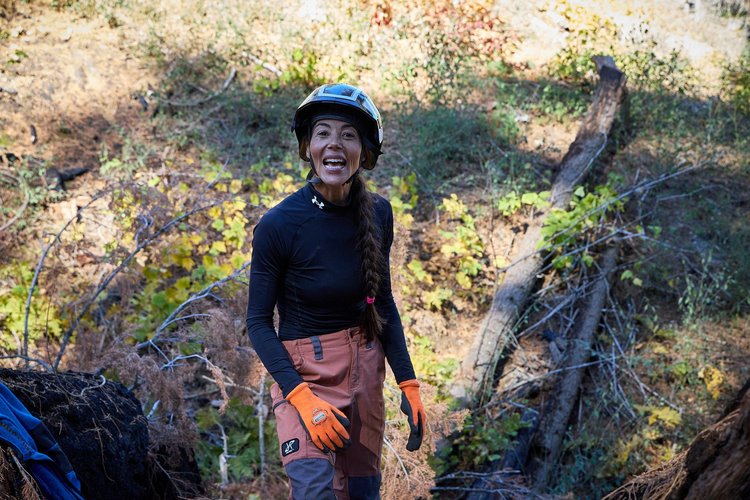
Bianca at the base of a giant sequoia in Parker Peak. Tule River Reservation. Photo by Wendy Baxter.

Being up there, you start to see the tree as a continually adjusting system.

What gradually became clear to me is that this combination — continued wood production, dead tops, and renewed crowns — is not accidental. Giant sequoias are built this way. Their enormous size isn’t simply a result of living for a very long time; it’s a product of their ecological niche and the environmental pressures they evolved under.

Seeing this firsthand made me realise how misleading it can be to talk about tree ageing as if it follows a single chronological trajectory into the future. Trees don’t age in isolation — they age within the ecological and architectural frameworks they evolved for. A giant sequoia doesn’t become squat with age because its world never asked it to. Its form reflects its context. For me, there is no better tree to understand aging both in terms of chronology and biology, than the giant sequoia.

When I first climbed Gemini in 2024, I had no idea how much it would change my trajectory as an arborist, and I’ve since been on another volunteer trip this last autumn. My work back in the UK slowly became less about the climbing and much more about the trees themselves — caring for them and trying to understand how they live and how they die, and how to take care of them.

My thinking about trees now is much more about curiosity than certainty. That shift has extended into my wider work. My thirst for knowledge grew out of time spent with the giant sequoia because when you stand alongside one of them, the first question is unavoidable: “how?” How do they grow so big? How do they live so long? The questions then loop endlessly.

On a more personal level, these trees have offered comfort at times when no human could. I arrived on one trip feeling broken — a little hollowed out, like an old oak. And yet, through time spent with the giant sequoias, I found myself standing straighter again, growing back towards the light as these trees do without even trying.

For that, I am deeply grateful — to the Ancient Forest Society, to Wendy and Anthony, Erin, Omayr, the entire team, and to the other volunteers. And especially to the remarkable people I’ve met through this work. It isn’t just about the trees, it’s about the people that these trees bring together.

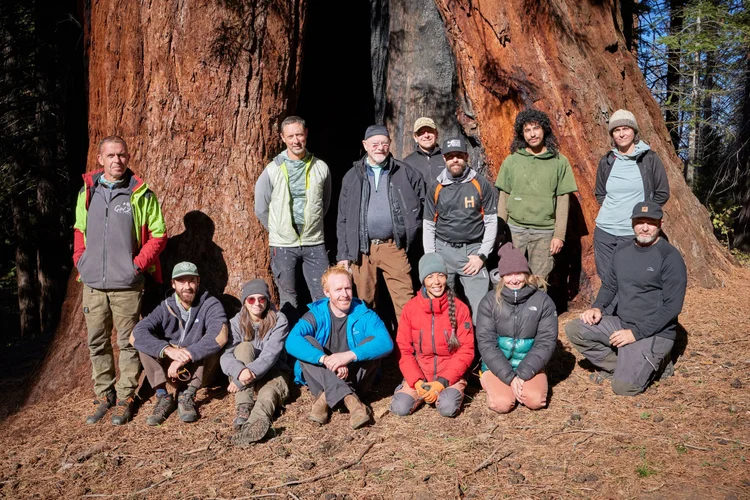
AFS team and volunteers, including Bianca, at the Parker Peak Grove. Tule River Reservation. Photo by Anthony Ambrose.

 SUPPORT OUR WORK 
 

Spreading the Word

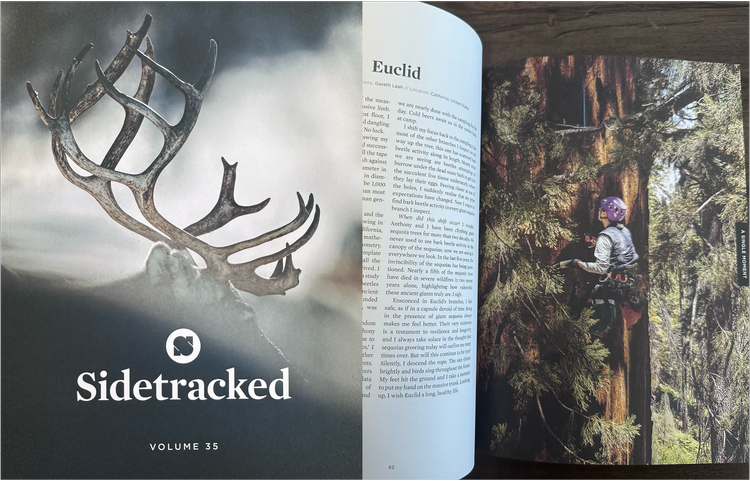
Sharing the importance of the work we do and inspiring people to love and respect trees is central to Ancient Forest Society’s (AFS) mission. AFS was invited to submit an article to Sidetracked Magazine to accompany a photo taken by Gareth Leah at Well Good Media. Wendy Baxter contributed a Single Moment piece about her experience climbing Euclid, the world’s 16th largest tree growing in Mountain Home Demonstration State Forest. It was a unique opportunity to try to sum up our work in a single moment from a personal perspective. Below is an excerpt from the end of the piece:

Ensconced in Euclid’s branches, I feel safe, as if in a capsule devoid of time. Being in the presence of giant sequoias always makes me feel better. Their very existence is a testament to resilience and longevity, and I always take solace in the thought that sequoias growing today will outlive me many times over. But will this continue to be true? Silently, I descend the rope. The sun shines brightly and birds sing throughout the forest. My feet hit the ground and I take a moment to put my hand on the massive trunk. Looking up, I wish Euclid a long, healthy life.

 BECOME A MEMBER 
 

Hug a Tree

One of the most powerful things you can do to protect our forests is to spend time in nature. You don’t have to travel to distant lands or old growth forests to appreciate the beauty of our natural world. Give yourself the gift of spending time outside in your own back yard or in open spaces where you live. The more we are able to reconnect with our natural world, the better we can internalize the reality that we depend on this precious planet for our survival.

Please also consider becoming a member or making a donation to Ancient Forest Society to support our work protecting ancient forests. Thriving, intact forests are the foundation of a healthy planet and human well-being. Every donation, no matter how small, can make an impact. During these uncertain times, fighting for the future of our forests is more important than ever. Join us today!


Did someone forward this email to you and now you want to sign up?

 JOIN OUR MAILING LIST 
 

Ancient Forest Society

This e-mail was sent to you by Ancient Forest Society. To ensure delivery to your inbox (not bulk or junk folders), please add our e-mail address, trees@ancientforestsociety.org, to your address book.

Ancient Forest Society, 870 Emerald Bay Rd., Suite 110, South Lake Tahoe, CA 96150, USA

Powered by Squarespace

Unsubscribe