$$PLAIN_TEXT_PREVIEW$$

View in Browser

Ancient Forest Society

Ancient Forest Society


Spring in the Giant Sequoias

by Wendy Baxter

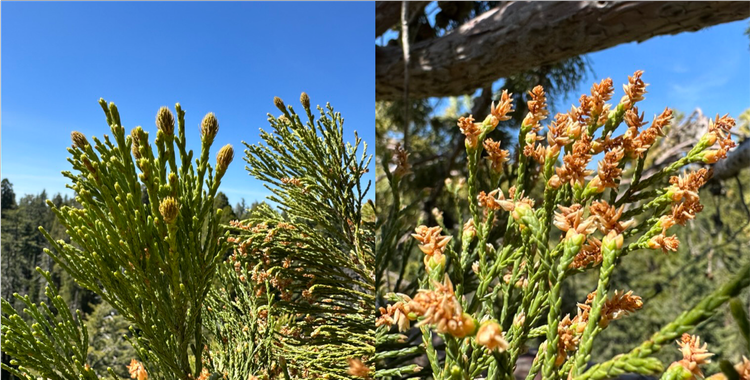
Winter ended early this year and spring is well underway. Our team was recently doing field work in Calaveras Big Trees State Park and noticed prolific male pollen cones as we hiked around the North Grove. Giant sequoias have both male and female cones, making them monecious plants. Their reproductive buds form in the summer and pollination takes place the following spring.

In the spring, male cones open up, letting their pollen be taken by the wind to hopefully land on female cones. After pollen grains land on female cones, it takes several months for fertilization to occur in late summer. The cones and seeds inside take until the end of the next summer to mature, which means it takes more than two years for a giant sequoia cone to fully mature. These green cones, which are photosynthetic, can stay on the tree for more than 20 years. 

You might wonder - if a tree has both male and female cones, can it pollinate itself? Yes, it can, and this is why when we collect giant sequoia cones, we collect primarily from the top two thirds of the tree to avoid collecting self pollinated cones which have reduced genetic variability.

Recently pollinated female cones on the left and opened male cones on the right. Photo by Wendy Baxter.

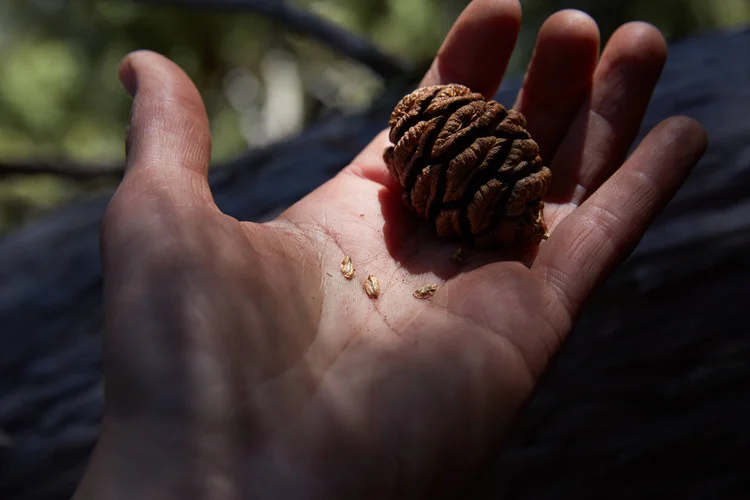
The ability of giant sequoias to hold their cones for such long periods ensures that large numbers of their seeds fall to the forest floor at just the right time. While giant sequoia cones are serotinous, meaning that the majority of their seeds are stored in the canopy awaiting an environmental trigger, they do not need heat from fire to open. Anything that kills a giant sequoia cone can cause its scales to flex and seeds to fall out. Each year, some giant sequoia seeds fall to the forest floor in what is called seed rain. What is critical however, is that the forest floor be prepared by fire to enable the seeds to germinate and get established. Fire stimulates the release of a large number of seeds at the same time. Giant sequoia seeds are tiny, about the size of a fleck of oatmeal, making them fragile and vulnerable to drying out. Fire removes the thick layer of leaf litter, exposing the mineral soil; a moist, nutrient rich location for the seeds to land and germinate. 

Giant sequoia seeds next to an opened brown cone. Photo by Wendy Baxter.

Giant sequoia seedlings thrive in small patches cleared by high severity fire. However, large contiguous areas of high severity fire, like in the wildfires in 2020 and 2021, can be catastrophic for giant sequoia reproduction. Mature trees died in great numbers in those areas, leaving no source of new seeds. While giant sequoia seedlings may be growing in those areas following high-severity fires, each year the number of surviving trees will dwindle, succumbing to being crushed, desiccated or burned. In those areas there is no longer a nearby seed source and their wind dispersed seeds can’t travel that far. Due to the tumultuous environment they grow in, giant sequoia groves require repeated reproduction events to ensure they survive and thrive into the future.

The threat of giant sequoia reproduction failure, caused by widespread, high-severity fire, is one of the reasons Ancient Forest Society is collecting seeds. In the wake of the 2020 and 2021 wildfires, large areas of some giant sequoia groves may not have enough seedlings to ensure that these magnificent trees will persist in those areas. Locally sourced seeds, banked before severe wildfire strikes, are an insurance policy for the future of these forests.

A dense patch of giant sequoia seedlings. Little Boulder Creek Grove, Giant Sequoia National Monument. Photo by Wendy Baxter.

 SUPPORT OUR WORK 
 

Celebrating Earth day

Come celebrate Earth Month and Earth Day with us at the South Lake Tahoe Earth Day Festival! The Festival is taking place on Saturday April 18th at the Lake Tahoe Community College. You can find out more about the event here. Ancient Forest Society will be there with other like-minded organizations that are celebrating the grandeur of our planet and fighting for its ongoing protection. There will be live music, a free raffle, an eco-kids zone and lots of great food vendors. We hope to see you there!

Sunset at Nevada Beach. Lake Tahoe. Photo by Wendy Baxter

 BECOME A MEMBER 
 

Join the Mission

You can be a part of our inner circle by becoming a member. Ancient trees play a crucial role in the Earth's ecosystem by acting as vital biodiversity hubs, providing habitats for a wide range of species, storing large amounts of carbon, providing critical ecosystem services and enhancing the spiritual and mental well-being of people around the planet. Climate change is rapidly altering the conditions which sustain ancient trees and forests, creating unprecedented threats to their survival. Our goal is to provide scientific insights that can help land managers address these threats. We also aim to inspire people to join in the fight to protect these amazing forests through outreach and education.

By becoming a member you can invest in these valued forests and join us in our mission to study and protect old trees and ancient forests. Your monthly donation will help us achieve these important goals.


Did someone forward this email to you and now you want to sign up?

 JOIN OUR MAILING LIST 

Ancient Forest Society

This e-mail was sent to you by Ancient Forest Society. To ensure delivery to your inbox (not bulk or junk folders), please add our e-mail address, trees@ancientforestsociety.org, to your address book.

Ancient Forest Society, 870 Emerald Bay Rd., Suite 110, South Lake Tahoe, CA 96150, USA

Powered by Squarespace

Unsubscribe